
By Jeff Kingsley
I would like to share a special realization I had some years back.
I was teaching at the time in a summer program called High School Diplomats. This program brings together high school students (usually juniors) from Japan and the United States, and I was one of the English teachers hired to teach language and culture to the Japanese students, while several Japanese teachers were hired to teach the American students.
In the lessons that I taught, I always tried to incorporate one particular lesson that focused on comparing the characteristics and values of American culture with those of Japanese culture. Not surprisingly, down the line these characteristics consisted mostly of polar opposites, such as being group-oriented vs. individually-oriented, or being more formal vs. informal in their social structures. I then challenged the students, based upon my understanding of dual characteristics, 4-position foundation and ODU (origin/division/union), to think about how something great might materialize out of something which typically produces the opposite effect of conflict and even war. I would then show theoretically how these two separate cultures (represented by circles) could eventually combine into something greater in the form of a yin-yang symbol with the East being the yin that would complement and fill in what the West (yang) was missing and vice versa. This sounded very principled and logical up on the board, but my challenge was to come up with specific examples of how such collaboration could actually be achieved.
So I began researching some examples, and I thought that the arts would be the best place to start. I wanted to pick examples of some people who would be well-known to my students, but I really had no idea about who might exemplify an East-West-type perspective. So I decided to look into the first name that popped into my head and that was Vincent Van Gogh. My knowledge of Van Gogh was basically limited to the Don McClean song “Vincent” that I loved when I was in high school. When I Googled him (it would have been so much easier with AI), I was pleased to find, and rather shocked because I had no idea, that Van Gogh was greatly influenced by the East in general and Japan in particular. He was said to have had one of the largest collections in the West at that time (estimated to be 600 or more) of Japanese woodblock prints called Ukiyo-e, many of which he displayed in his home, and he consequently incorporated some of these techniques in his art! I wonder how many people know that about Van Gogh. Based on this knowledge, it occurred to me that perhaps Van Gogh’s greatness, and that special something that people feel when seeing his work, is a result of his bringing together Eastern and Western artistic perspectives and thus embodying more fully the nature of our Creator. This was my first WOW!
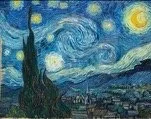
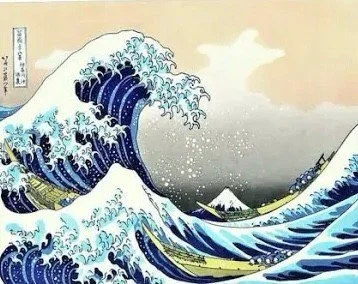
Next, I wanted to look into a famous Japanese artist, and I went with the first thing (and only thing) that came to mind which was the artist (I didn’t know his name then) who created the “Great Wave of Kanagawa,” which I knew about only because I remembered it as one of the iconic foil prints that I sold when I was on CARP MFT in the 80s (along with the bear and the lollipop etc.). It turned out that the artist’s name is Hokusai, who is considered perhaps the preeminent Japanese artist of all time. Doing further research, I discovered that, to my surprise again, that Hokusai was influenced by Western art, even at a time (Edo period) when Japan was almost completely shut off from the West. Apparently, the only people let in were some Dutch traders who brought goods to Japan, including Dutch artwork. Upon further research, I found out that “The Great Wave of Kanagawa,” along with some of Hokusai’s other works, did, in fact, combine East-West techniques! And on top of that, art historians believe that Van Gogh, who was a known admirer of Hokusai, may have incorporated the swirling form of Hokusai’s “Great Wave” into his rendition of the night sky in “The Starry Night”! So, with these discoveries, I had my second WOW!
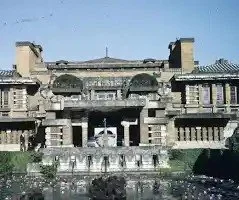
And finally, I wanted to find some example of a well-known person in the architectural realm with such a perspective, and again, didn’t have any idea who that might be or if such a person existed at that level. With my limited knowledge, the only name of a famous architect that I really knew was Frank Lloyd Wright, so I thought I would start there. Here again, what I found blew me away (see “Frank Lloyd Wright and Japan, An Architectural Love Story — Deeper Japanz”)! Suffice it to say that Frank Lloyd Wright was not only influenced by Japanese architecture, it turns out that he actually lived in Japan from 1917-1922 and was commissioned by the Japanese government to create the Imperial Hotel in the middle of Tokyo, in addition to designing several other notable works in Japan. Needless to say, this was my third WOW!
What’s the upshot of my experience? On one level it’s the realization of how special and, yes, even magical it can be when we see ODU not just on the blackboard but being put into action, in this case through the arts (See Kevin McCarthy’s lecture on the Principle of Creation starting at 26:45: Principle of Creation Part 1 DP kmdp02 Divine Principle lecture Eng. Rev. Kevin McCarthy). I don’t believe these amazing people just mentioned would have achieved their enduring influence and status without the imprint of God’s hand through ODU. It’s amazing what they were able to create through combining East and West in their works.
On another level, it makes me realize even more the ingeniousness of the numerous international and interracial Blessings Father and Mother bestowed upon us. Is there any other church group in America that has such a high percentage of its congregants who are either involved in an intercultural or interracial marriage themselves or are the product of such a union? And based on this, what types of amazing works in all of the arts could potentially be created within our community combining these diverse races and cultures? How many potential Van Gogh’s, Hokusai’s and Frank Lloyd Wright’s might there possibly be residing within our Movement as a result?
And finally, based on this and other experiences, I was recently moved to connect to Carol Pobanz to discuss the possibility (it hasn’t been finalized yet) of creating a community art project within our NJ Family Church which can reflect our uniqueness as an interracial, intercultural and interreligious community. As evidenced by the recent article in the Wall Street Journal last July (“Madison Square Garden’s Last Wedding Was for 2,000 Couples at Once”), mainstream America may still view our Blessings and our community as consisting of a somewhat faceless mass of people rather than being the beautiful diverse mosaic that it actually is.