
Jesus’ Life and Ours
For this Easter season, we can reflect on what we know of Jesus and what it means for members of the Holy Community. Let us look at His childhood, young adulthood, invaluable sacrifice, sacred resurrection, eternal commitment and finally, the concept of messiahship.
Some profound understandings are available to us through the inspired words of Rev. and Dr. Moon and their first disciples. For that reason, commentary is minimal, so as not to diminish the force of the quotes.
Childhood
I still recall one Christmas morning in the Manhattan Center, when Father Moon called many local teams in from fundraising to hear a poignant and stirring Christmas message. These are just snippets from it:
When Joseph married her, Mary was pregnant and Joseph knew that it was not his child.…how long do you think Joseph could feel righteous and happy about it?…Joseph looked upon Jesus as something which was not wanted and which had ruined his relationship with Mary.
…Because of their parents’ attitude towards Jesus, even his own brothers and sisters did not respect him… Whenever parents respect a child then his brothers and sisters will also, but when the father and mother are indifferent or hostile, then the chances are that the other children will treat him the same way.
…Even now in a society as permissive as America’s, if a girl has a baby whose father is not known then there is some talk about it. An even harsher situation prevailed in Jesus’ time…. Certainly there would be cruel gossip. …Every child that Jesus played with certainly must have made comments about things heard from his parents.
…even on holidays or special occasions no one made special clothing or gifts and presented them to Jesus. …Mary was reluctant to anger Joseph by giving anything to Jesus. Of course Jesus must have wanted to wear the special clothes and eat the special food of that time, like we all do, but it was not possible to acquire it.
- The Participants in Celebrating Christmas, 12/25/77
Young Adulthood
In this section, we will look at quotes from Dr. Young Oon Kim. She was the very first missionary whom Father Moon sent to the USA. She had earned her doctorate in North America, spoke and wrote extensively in refined English, and she deeply appreciated and loved Jesus as well as the voice of God in the scriptures in the world’s great religions. Besides teaching World Religions at UTS, she directed her considerable energy to publishing many volumes devoted to building strong bridges of deep appreciation and understanding between the HSA-UWC, Jesus and those who lovingly revered Him. Here, we learn a remarkable insight into the Gospel narrative which first emerged among Christian theologians around the 1960s (just when Father Moon began his global mission in earnest):
…at the start of his public life Jesus…speaks and acts as if the divine kingdom was dawning. For example, to counteract the bitter religious animosity between Jews and Samaritans, Jesus taught the parable of the good Samaritan. To remove the antagonism between Jews and Romans, Jesus praised a Roman centurion for having greater faith than anyone in Israel. In opposition to the rigid social caste system, Jesus openly ate with publicans. And at a time when women were considered inferior to men, Jesus welcomed them into his intimate circle.
- Unification Theology, Dr. Y.O. Kim
Liberal Biblical scholars contrast two periods in Jesus’ ministry: The early days which are compared to a “Galilean springtime” and a later period when Jesus faced dangerous opposition.
At first there seemed to be a real chance that Jesus’ ministry would be crowned with success. …a momentous change occurred as soon as the Pharisees persuaded Herod Antipas to suppress Jesus’ movement.
To avoid a perilous clash with his Galilean enemies, Jesus fled secretly to pagan Tyre and Sidon…, then spent time outside Herod’s realm in the Decapolis area…. Guignebert describes this period as the erratic flight of a man who felt hunted.
- various theologians, Unification Theology, Dr. Y.O. Kim
There are several clear signs pointing to his seeming lack of success (Mark 8, Matthew 13). The religious leaders had not accepted his preaching. The crowds which had previously been enthusiastic now began to abandon him. Jesus’ disciples failed to understand him. …there were two attempts to stone him.
All the Gospels hint that Jesus faced a serious inner as well as external crisis…. He seems to have been tempted to withdraw into seclusion, restricting his teaching to the small core of chosen disciples. …there took place a radical change in his understanding of himself and his mission. Jesus was forced to reshape his faith.
- Unification Theology, Dr. Y.O. Kim
From the Ashes…
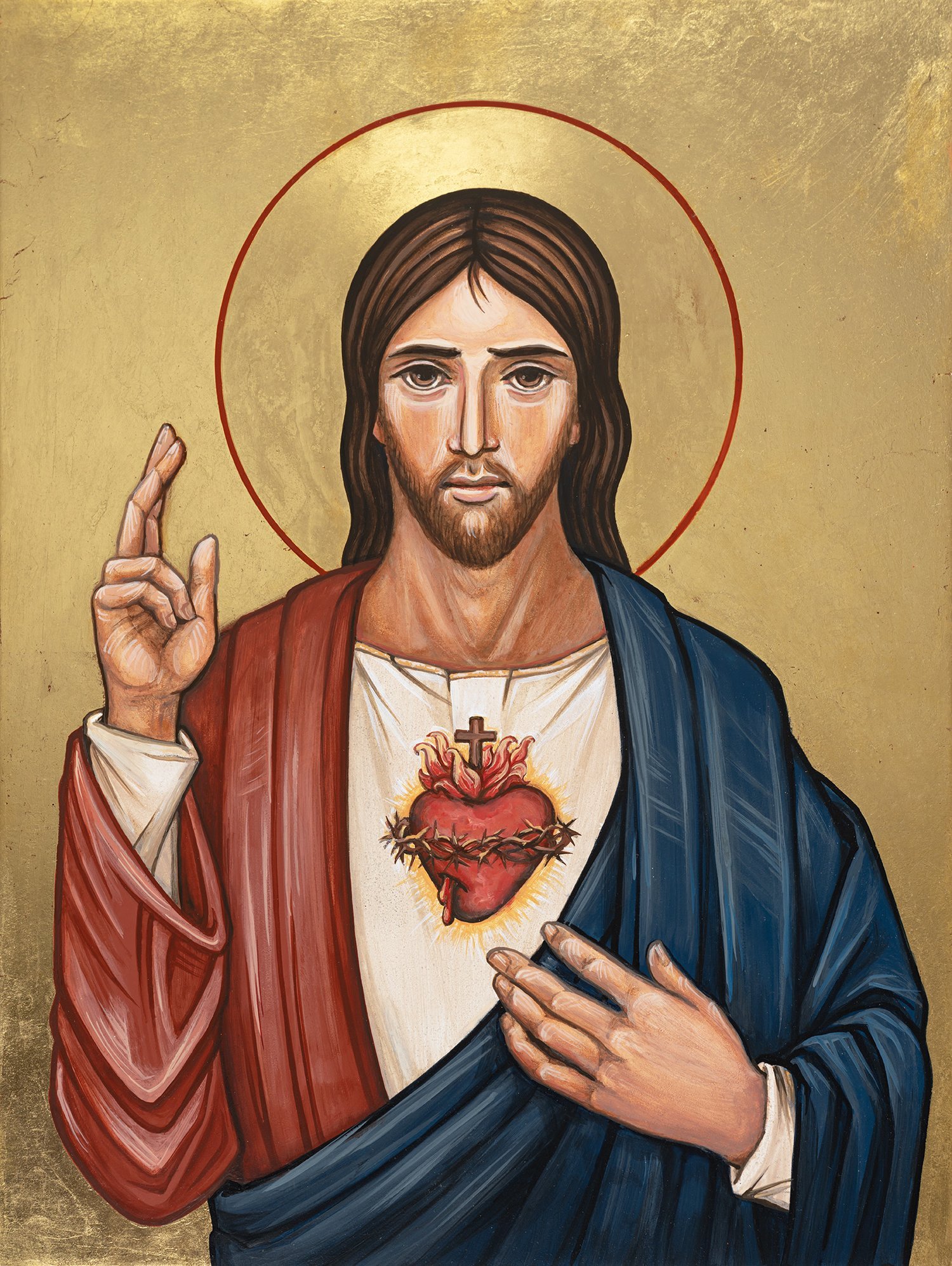
There is an emotionally laden icon of Jesus called The Sacred Heart, but it’s so common that it’s often taken for granted and skimmed over more than truly seen and understood. But quotes like the following brought home the full weight of that icon and elevated my understanding and reverence for Jesus to a different dimension:
If he chose, he could have fallen prey to self-pity and asked why he should go the miserable way of the cross. He could have set the entire universe in motion to breathe a deep sigh of despair with him.
God had a mind to pass judgment immediately, judgment that was even greater than that of Noah’s time.
Instead…as he neared death Jesus said, ‘Father, forgive them, for they do not know what they are doing’. …Jesus died clinging to the nation, clinging to the religious establishment and clinging to the cross. For this reason, God could not abandon humanity but held on to us.
- PHG, Book 5, The Life of Jesus as Seen from God’s Will
Eternal Commitment
Two more quotes that reveal the utterly selfless heart of Jesus more deeply:
Since Jesus was human…bitter feeling must have sunk deep in his mind and the feeling of great indignation must have overflowed his heart. However…Because Jesus realized that humankind would be destroyed if he cursed at this people, he could establish one standard of salvation.
If Jesus had expressed his feeling of being mortified according to how he felt…this world would have its hope all disappear. This world would have seen its end then.
- Let Us Understand the Heart of the Resurrected Jesus, 4/17/58
…it was the moment of anxiousness and seriousness when the second will of providential salvation had just been inherited and started its dispensation. That is how God could establish Jesus as the executor of the second salvation, and to command the grace of resurrection over humankind.
- Let’s Be the Person Who has the Heart of Jesus, 1/26/58
Messiahship
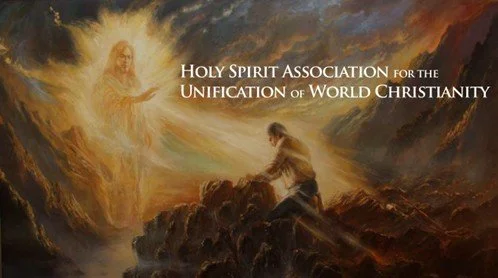
In this closing section, it’s necessary to do a very quick recap of the first real meeting between Jesus and Father Moon. According to his autobiography, it was Easter Sunday, he was 16 and in desperate prayer about the misery and suffering he saw everywhere. Jesus appeared and asked him to gather Christianity together and complete the providence of restoration. Overwhelmed by fear at this enormous request, Rev. Moon wanted to decline, but when Jesus persisted, he had to accept that—as shockingly incredible as it was—this was in fact the answer to His prayer. With great trepidation, He accepted and, that Easter day, the seed of the movement was planted. (Peace Loving Global Citizen, p. 49–50.)
Next, we can review the concept of the Trinity, paying special attention to the explanation of the position of Jesus and the Holy Spirit:
When we believe in Jesus as the Savior through the inspiration of the Holy Spirit, we receive the love of the spiritual True Parents, which is generated through the give and take between Jesus, the spiritual True Father, and the Holy Spirit, the spiritual True Mother. …This is spiritual rebirth.
- Exposition of the Divine Principle, p. 171
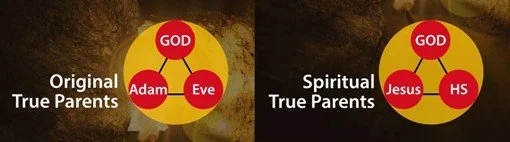
It doesn’t stop there however: a very particular responsibility is inherited by those who have been spiritually reborn. That responsibility has to do with a well-known but largely misunderstood term—Royal Family. The correct meaning of that term is made clear in the Holy Books:
What is the realm of the royal family? It doesn’t mean the direct children of Adam and Eve. There is still this fallen world to be restored. Although you may have been restored yourselves, still, centering on the Blessed Families, centering on your own children, the Cain realm remains to be restored, as does the tribal messiah realm, and also the Cain realm on the world level.
- Cheon Seong Gyeong 2006, p. 2465
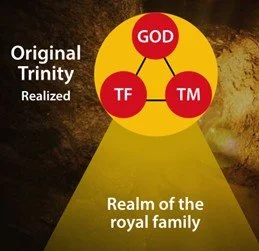
That means that the term Royal Family includes all of God’s lost children—meaning all those in the world-level Cain realm who are still unaware of their original position and true identity as God’s children.
They can be awakened to their original, true regal status through the Home Church work of the Tribal Messiah:
In your tribal-level realm, you pursue Home Church activities. Even if you are opposed and called names, you need to love the people with tears.…the Home Church becomes the foundation of your tribal messiahship. …The Home Church foundation is the Cain foundation and your own family’s foundation is the Abel foundation.
- Cheon Seong Gyeong 2014, p. 929, 940–1
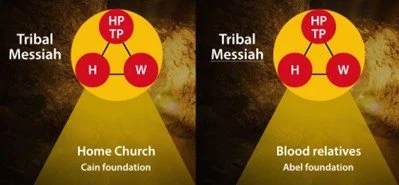
When Tribal Messiahs can bring together their own Blessed Families (Abel) with awakened, well-educated families in their Home Church (Cain), the misunderstanding of and the difference in identity between the two can be dissolved and thus, the complete Realm of God’s Royal Family can emerge.
On that foundation, there’s a “homecoming” for the Tribal Messiah families who’ve established their united Home Church. Indeed, it’s the culmination of their messianic responsibility:
If you ask where you will be sent as family messiahs, it is to your family, your blood relatives.
- Cheon Seong Gyeong 2014, p. 931
It’s here that the lessons and experience of all the previous work are fulfilled:
The purpose of Home Church activity is to train you to love more. …Then when you return to your family…you need to love your family members hundreds of times more than you loved your Home Church. (104-064, 1979.03.28)
- Cheon Seong Gyeong 2014, p. 929
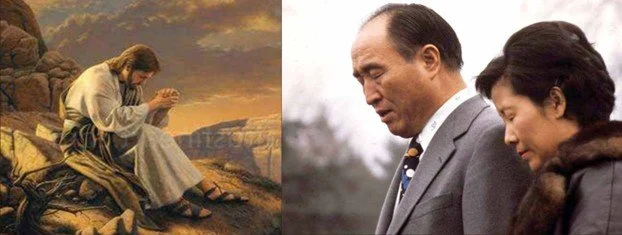
So with that, we might easily guess one key focus of the prayers of history’s central messianic persons.
All photos contributed by Ricard Lewis