
How Did God Make The Universe
by Richard Lewis, PhD
All photos submitted by R. Lewis
A scientific atheist once asked me, “If the universe is made of energy, where did God get the energy to create it?” I replied, “I’m glad you asked—science has actually figured out the answer.”
Because he was a scientist, I explained it quickly in a TikTok-style response, and he liked it. I’ll do the same here, but without technical language.
Big and Small Numbers
First, we need to talk about very large and very small numbers. Look at the number written as 10⁶. Which part seems more important—the 10 or the 6? Most people think the 10 matters most, but they’re wrong. The 6 is the key, because it tells us how many zeros there are. 10⁶ means 1,000,000—a 1 followed by six zeros. Scientists write numbers this way because it makes extremely large or tiny quantities easier to handle. For example, one-millionth is written as 10⁻⁶, which means 0.000001. Modern physics goes even further and uses what are called natural units. In these units, the speed of light is set to 1. When we do that, ordinary measurements become enormous:
One second contains about 10⁴⁴ tiny time units
One meter contains about 10³³ tiny length units
This system helps scientists describe extreme events, like the birth of the universe.
Spacetime
Next idea: according to Einstein, space and time form a single reality called spacetime. Spacetime is not a traditional “substance” like matter, but it is physical and dynamic. It can bend and curve, and those curves affect matter and energy. Mass bends spacetime, and spacetime tells matter how to move. In this sense, spacetime is not just a background or a concept—it is a fundamental part of reality. Some physicists even think it may emerge from something deeper at the quantum level. Modern physics suggests that light and matter are not separate substances, but rather energetic patterns—twists in space along the time axis.
Light behaves like open waves
Matter behaves like closed loops
Because space has three dimensions, these twists can involve one, two, or all three directions—usually called x, y, and z—along with the time direction that we all move through.
Quarks, Gluons, and the Strong Force
The twists that involve all three spatial directions are special.
In light, they are called gluons
In matter, they are called quarks
These twists are so intense that they cannot exist freely. They must be tightly confined inside particles like protons. Trying to pull them apart requires an enormous amount of energy. If you attempt it, the energy you put in immediately turns into new particles. This powerful binding is known as the Strong Force. In fact, most of the mass of ordinary matter does not come from the quarks themselves, but from the energy of the Strong Force holding them together. When separated, quarks contain an enormous amount of stored energy.
Inflation and the Origin of Energy
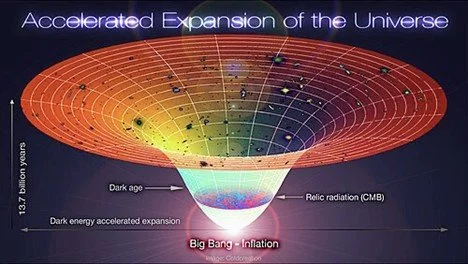
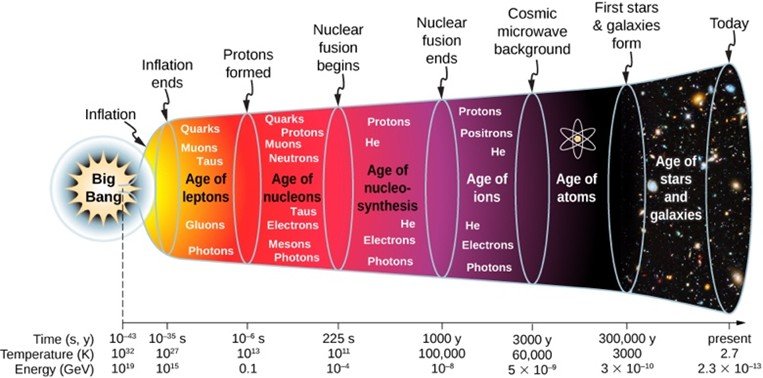
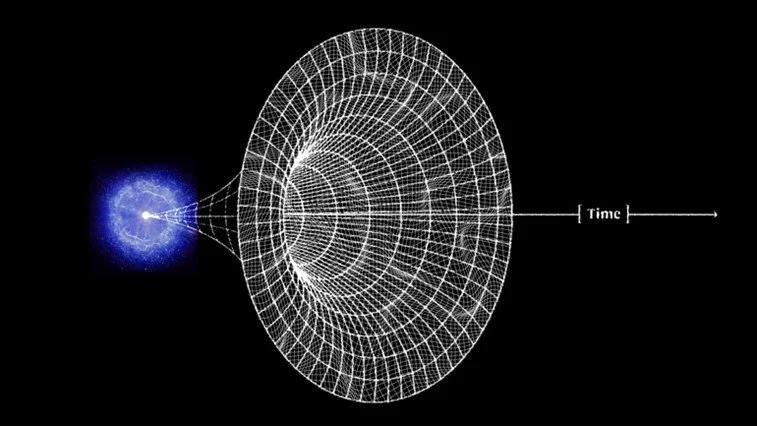
Here is the key point. The Strong Force does not react instantly. Its reaction time is incredibly short—about 10⁻²⁸ seconds—but in the tiny units of spacetime, that is still a long delay. At the very beginning of the universe, everything existed in an unimaginably small and dense speck, sometimes called the cosmic seed. This seed was created by God, along with the Logos, to automatically guide its development toward humanity. During the brief moment before the Strong Force could react, spacetime expanded at an extraordinary rate. This event is known as inflation. In that fraction of a second, the universe doubled in size again and again—trillions of doublings in an instant. By the time the Strong Force finally reacted, the universe had grown by an incomprehensibly large amount. Quarks that were once together had been separated across vast distances. That sudden release of energy, as the Strong Force reacted, is what we call the hot Big Bang, which effectively ended inflation.
The Final Answer
About 13 billion years later, we humans appeared in a now-cooled universe. So, when asked where the energy came from, the scientific answer is surprisingly simple: It came from the structure of spacetime itself. The universe did not need energy brought in from outside. The energy emerged naturally as spacetime unfolded according to its own laws. And all of this, as we understand it, reflects God’s brilliant design of the Logos—the set of natural laws through which creation unfolds.
All images submitted by R. Lewis