Spiritual Grounding
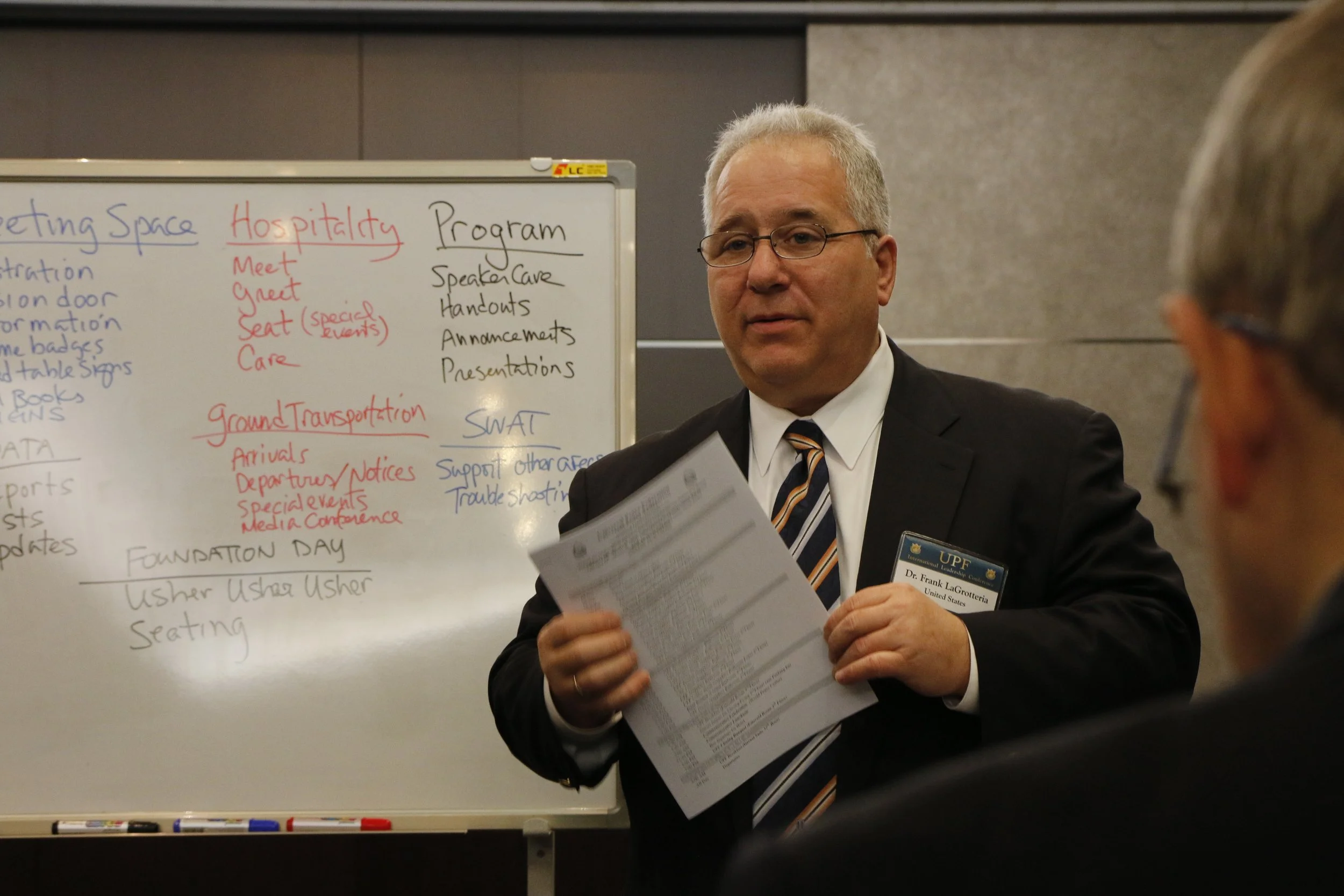
all photos provided by F. LaGrotteria
By Frank LaGrotteria
Presently, I’m working at HJ International Graduate School. I have operational responsibility for many of the areas the school has to manage—compliance issues, legal issues, HR, finance… all the things I’ve done throughout my career in the church. I’ve been able to work on projects in the non-profit arena and do the administrative and operational work I’m familiar with, and I’m very, very grateful for the path I’ve had.
I truly believe I’ve been blessed. I’ve received so many opportunities to support the Providence in different ways—now here at HJI, but previously with UPF, with Bridgeport International Academy (BIA), with the Universal Peace Federation and all its earlier iterations—stretching all the way back to when I graduated from the seminary in 1994. I’ve been very fortunate to be part of True Parents’ frontline activities during the last 20 years of True Father’s life.
All of us have certain principles—cornerstones we come back to again and again—until one day we realize, “Yes, this one is fundamental.” I have eight such principles. I mentioned them briefly in my final speech at Bridgeport International Academy, though I didn’t go into much depth at that time. I’d like to take the opportunity with this article to do that now—to communicate these points, born out of my experiences, the challenges I faced, and the conclusions I reached in working through them.
So let’s get started.
First Point: We do the mission
And that mission is, at its core, to transmit values. It’s not to make money. It’s not to put on an event. It’s not to move boxes or handle whatever practical responsibilities land on our desk.
We have many leaders in our movement, in all kinds of fields—and it’s so easy to let ourselves be defined by the activity. For almost three decades, I was a conference manager, an operations guy. I lived and breathed getting events off the drawing board and into practical reality—at hotels, airports, banquets—wherever they needed to happen. The temptation is to let yourself be defined by those external responsibilities.
At BIA, for example, it was my job to make sure we enrolled enough students to generate the revenue needed to keep the school open and continue our work. And in many ways, I allowed myself to be defined by that urgency—by that sense of financial pressure.
Well, after all of that, here’s my conclusion:
That’s not the mission. The mission is not simply to raise money or keep your school open, or even just to operate an NGO. Yes, there’s a mission statement, but to truly be successful you have to know the core of your work. Otherwise, the external pressures will crush you. They’ll define you. And you’ll miss the mark. For me, the mark is this: to transmit values.
At every juncture, in every stage of our activity, we are constantly modeling the behaviors we want to see reflected in society.
If you’re facing an enormous responsibility or challenge—something that requires a new skill set, more determination, or a deeper investment—then you model the behavior necessary to meet that challenge. The mission is to model those behaviors. The mission is to show, by example, what a person facing such responsibilities should do. It becomes essential that you are always transmitting values.
You could find yourself in a hostile situation, even in an argument. The real question is: How are you handling yourself? Did you lose your cool? Did you attack the other person? How did you compose yourself? That, too, is the transmission of values.
We can’t always control external conditions—though we can choose some aspects of our work—but fundamentally, the mission remains the same. And it never goes away. The mission, as I define it, is to transmit values until my last breath.
My mother was like that. In the last stage of her life, down to her final breath, she repeatedly said, “I will love you forever and pray for you always.” She lived that. She modeled that. And I want to be that kind of person—constantly transmitting values until the end. Even at the very end, you can model how to approach death, how to finish your course on this earth, and what example you leave for your children, your grandchildren, your colleagues, and even the world.
Second Point: Do No Harm
This is, in a way, the flip side of everything I just said. We hear the phrase “do no harm” all the time. If you can’t add to the situation, at least don’t make it worse. In the immortal words of Thumper’s father: “If you can't say somethin' nice, don't say nothin' at all.”
But our immaturity, our limitations, our habits—these can absolutely make things worse. By how we approach things, how we speak, what we believe, how we manage ourselves—we can unintentionally damage the very situation we’re trying to improve. So, at the very least, if you can’t advance the mission, don’t harm it.
Third Point: When in Doubt, Serve Your Way Out
No matter how difficult the circumstances around you, no matter how overwhelmed you feel—and sometimes you can’t help feeling overwhelmed—there is always someone you can serve.
There’s always something to clean. Something to repair. Someone to encourage. Someone to write a note to. You will never run out of people to serve.
And when you’re doing your mission—really living it—there are a million ways to support others. That’s why I say: don’t make things worse, but you can always make them better. Even if you can’t address the big issue, you can address a thousand small ones. They add up. They create the atmosphere, the momentum, the spirit that says: We are here to work. And we will do everything we can to accomplish our mission.
So: Do no harm. Serve your way out.
Fourth Point: Believe in the Power of True Love and Forgiveness
I don’t think we fully understand the power of true love. We treat “love” as a nice idea, a sentiment. But the Principle teaches us something more radical:
Love is a power – A real, concrete, transformative power. And forgiveness is also a power—almost a superpower. In the real circumstances of life—when you’ve been hurt, when you’ve hurt others, when relationships are tangled or strained—the ability to forgive is a profound power.
Never underestimate the power of true love and forgiveness.
We often think, “I need more skills. I need to do master coding. I need to understand AI. I need another degree, another certification.” And yes, those are valuable. But let me say clearly: true love and forgiveness are powers at least equal to those skills—if not far greater.
Believe in the power of true love. Don’t treat it like a side note or a cliché. It is a real power. And you can actually use it. But you have to have it—the capacity to love others and forgive them.
God has done the same for us. So why can’t we do it for other people? That is the real secret of forgiveness.
People often say, “I can’t forgive that person—they hurt me so badly.” All right, but what do you think God thinks about that? He loves and forgives us. He doesn’t condone our sins, but He still loves and forgives us. And He doesn’t just love and forgive me—He loves and forgives everyone. So, are we somehow greater than God? Have we been hurt more deeply than God Himself? Do we really have the right to withhold forgiveness?
Of course, getting to true forgiveness is a process. It requires deep reflection, introspection, and an honest inventory of our own situation. Working our way toward forgiveness is difficult—sometimes wickedly difficult—but it is possible. And it is powerful. Not holding something against someone else liberates your own heart, and it also frees the other person. So, believe in the power of true love and forgiveness.
Fifth Point: Stay in Your Lane
I’ve heard arguments both for and against this phrase, but I’m a big believer in systems thinking. I wrote about it in my seminary dissertation, and I’ve appreciated the work of Rabbi Murray Bowen, a psychiatrist, who developed the Bowen Family Systems Theory. Along with Rabbi Edmund Freidman, a family therapist, and leadership consultant. These two Rabbis both described how human beings live within systems.
The human family is the prototype—the archetype—of all human relationships. In a family, each person has a position: the father figure, the mother figure, the child, the siblings.
Each role is unique. Everything is not interchangeable. Each person carries certain responsibilities, and the success of the system depends on people staying in their lane—doing what is theirs to do.
This doesn’t mean neglecting anything. It means understanding your role, embracing it, and doing everything in your power to fulfill your responsibility.
We often run into trouble when we start criticizing others, compensating for others, or even overcompensating by doing someone else’s job for them. It may feel helpful in the moment, but in the end it isn’t. When you do someone else’s responsibility, you free them from having to do it themselves—and they lose the challenge and growth that their role requires.
But when you discipline yourself to stay in your lane, you indirectly push the other parts of the system to do the same. Your consistency helps clarify what others must do. When you do your job well, it becomes obvious what still isn’t getting done—and who needs to do it.
This is why staying in your lane is so important. It grows directly out of systems thinking. And this applies far beyond the family. The family model appears everywhere:
– in schools
– in workplaces
– in government
– in all human communities
The scale may increase, the structure may become more complex, but at heart, humans “do family.” It’s in our physical DNA and our spiritual DNA. God made us that way, and we practice family wherever we go.
Bowen and others point out that this is not without structure. Much depends on differentiation—being able to hold your own responsibility while recognizing what belongs to others. The success or failure of any system depends on individuals maintaining that boundary. This reflects the Principle’s idea of the self-purpose and the whole-purpose. Each role is distinct and narrowly defined, yet at the same time each role contributes to the larger whole. Fulfilling your individual responsibility strengthens the entire system.
Of course, sometimes life requires intervention—if there is danger, or risk of real harm. But the ideal is that each person fulfills their responsibility, and the collective unity that results creates a healthy, functioning system.
Sixth Point: Unite the Public and the Private
We live in an age—especially in America and other developed nations—where everything revolves around the individual. The message we constantly hear is: “Do what makes you happy. Put yourself first. Sacrifice whatever or whoever you need to in order to get what you want.” But this mindset creates a deep imbalance. When we prioritize only our private desires—our personal comfort, our personal gain—we lose sight of the public dimension of life: the good of the family, the community, the nation, and the world.
A healthy life unites the public and the private. It doesn’t reject the individual, but it doesn’t worship the individual either. Your private life—your personal passions, talents, hopes, and dreams—matters. But your public life—your duties, responsibilities, contributions, and sacrifices—matters just as much. They are not meant to compete with each other; they are meant to harmonize.
When you live only for your private self, you become isolated, anxious, and ultimately unfulfilled. When you live only for the public, you risk burnout, resentment, and losing your sense of identity. But when the two are integrated—when your personal strengths support your public mission—you become whole. You become powerful. And you can truly serve others without losing yourself. In other words, a life of purpose requires both personal integrity and public responsibility. The more we align those two realms, the more joy and meaning we discover.
My experience has taught me that the public and the private have a perfect relationship with each other. When we understand this, we can clearly recognize what needs to be done—and when it needs to be done.
Sometimes, we have to sacrifice. We don’t like that word. None of us likes being told we have to do something. But there are moments when we must sacrifice ourselves for the sake of others. That’s the core of the relationship between the public purpose and the private individual. You can’t sleep all day if your children need their clothes washed, or a meal, or a ride. You give up some comfort for someone else’s well-being. That’s a small example, but it points to something much larger.
It’s not about someone restricting our freedom. It’s that we naturally want to support the greater purpose—if we understand it. We need to know when the time for sacrifice has come, instead of complaining that our comfort zone is being disrupted. In our society today, we often get this backwards. We’ve become self-centered, even narcissistic, championing our personal needs while treating the needs of the larger whole as secondary. In reality, it’s the opposite. Living for the sake of others means recognizing the greater purpose and sacrificing when needed.
There is a deep interplay between the public and private. When we get that order right, we succeed. True Father has said many times that a person with a clear conscience—someone who understands the greater purpose—knows what to do. They’re not confused or conflicted.
Of course, we also need sleep, food, and basic care. We aren’t always serving the whole; often we’re taking care of ourselves. But these two aspects—public and private—are not opposites. They are complementary. And when we understand their relationship, we can be genuinely happy and satisfied in making sacrifices for the greater good.
Seventh Point: Have Faith
The next point is simple to say but hard to practice: Have faith. Faith is not just something that some people have and others don’t. Faith is part of our human responsibility. It’s not enough to have skills, work hard, put in the time, follow instructions, overcome limitations—though all of that matters. In the Principle, we talk about the 95% and the 5%. God does 95%, and we do 5%. Part of that 5% is faith. Not blind or foolish faith, but realistic faith: you have done everything you possibly can, and now you trust that God is involved in the outcome. You don’t simply say, “Well, now it’s in God’s hands,” as if stepping back is enough. Instead, by making your utmost effort, you open the door for Heaven to work with you. I’ve experienced this hundreds of times. I call it “getting to the end of your giving”—emptying yourself out, doing everything possible to accomplish the goal, leaving no stone unturned. But even that isn’t enough. You must also believe. That is part of responsibility.
The Eighth Point: Never Give Up
The last point is straightforward: Never give up. Never, never give up. I believe we have responsibility until the last breath we draw on this earth. As our circumstances change—our health, age, abilities—yes, things may slow down or shrink. The circle of what we can do may get smaller. But at every stage of life, there is still a responsibility we can fulfill. It’s not a checklist we finish early. It lasts until the end. Even someone struggling with illness or cognitive decline still has some level of responsibility—something left to offer—until their course is over.
In Summary
Here are the points we reviewed:
Our mission is to transmit values.
Be part of the solution, not the problem.
When in doubt, serve your way out.
Engage the power of true love.
Stay in your lane.
Unite the public and private.
Have faith.
Never give up.Top of Form