
Shall I Make Three Booths?
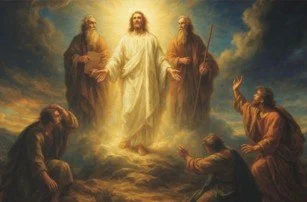
The Transfiguration Matthew 17 1-9 RSV(CE)
17 And after six days Jesus took with him Peter and James and John his brother, and led them up a high mountain apart. 2 And he was transfigured before them, and his face shone like the sun, and his garments became white as light. 3 And behold, there appeared to them Moses and Elijah, talking with him. 4 And Peter said to Jesus, “Lord, it is well that we are here; if you wish, I will make three booths here, one for you and one for Moses and one for Elijah.” 5 He was still speaking, when lo, a bright cloud overshadowed them, and a voice from the cloud said, “This is my beloved Son, with whom I am well pleased; listen to him.” 6 When the disciples heard this, they fell on their faces, and were filled with awe. 7 But Jesus came and touched them, saying, “Rise, and have no fear.” 8 And when they lifted up their eyes, they saw no one but Jesus only. 9 And as they were coming down the mountain, Jesus commanded them, “Tell no one the vision, until the Son of man is raised from the dead.”
The Transfiguration Matthew 17 1-9 RSV(CE)
I chose this passage, for a very specific reason. Jesus came as the Messiah. The Lord. The King of Kings. The Son of God, the only begotten Son of God. What an incredible role, mission and position he had. No one understood what this meant. It was beyond anyone’s capacity to understand in that period of time.
The Jewish tradition didn't really paint an accurate picture of what the Messiah might be like, or what that role might entail. When we look back by reading the Gospels, when we study biblical literature, we come to understand that Jesus was an amazing human being. He was able to heal others, he touched their hearts in a profound way and, after his passing, after the crucifixion, within a relatively short period of time, Christianity and the message of salvation spread like wildfire. Christianity has since influenced the entire planet, transforming Western civilization in the process.
In order for us to set the table for what is happening on the Mount of Transfiguration, we need to imagine the context of the situation. Seen through just an historical lens, Jesus is an amazing figure, and even a supernatural figure, as our Christian friends will doubtless remind us that Jesus is God Himself. Imagine then if you were anywhere near this man—he carrying such an amazing mission of being the Messiah, the one who comes to save human beings. He has such a lofty goal and yet, he gathers around him lowly fishermen, tax collectors and prostitutes. These followers are not highly educated people, not very sophisticated and certainly not scholars, religious leaders, or the cream of the crop, so to speak. But they are nevertheless simple, sincere, common, hardworking types—perhaps not really understanding much of what Jesus has been saying or certainly not who he is. In some ways, they really don’t know who they're dealing with.
Jesus leads Peter, James, and John up a high mountain. I love that high mountain. For those of you who hike, and I do, a high mountain is very different than, say, foothills. A high mountain is challenging like when we visited Masada the site of the AD 72-74 siege during the pilgrimages to Israel from 2003 – 2006. There's Jesus leading Peter, James and John up this high mountain, and surely, he is prodding them and encouraging them to keep going. When they reach the top, suddenly Jesus is transformed. What does it mean? From a Divine Principle perspective, it most likely means that he was talking about his spiritual body and the spiritual bodies of Elijah and Moses, who have likewise appeared. Divine Principle describes human life in the three stages, the womb (water), the earth (air), and the spirit world (love). In the Spirit World, we are told we have a spirit body. These three spirit bodies appear and are seen by Peter, James and John. To an earthly eye, or an earthly perspective, they would appear to be bright shining lights beyond anything that they had ever seen before. It is not hard to imagine that Peter, James, and John were completely overwhelmed by this scene.
I think it's beautiful what Peter says here in verse 4—"Lord, it is good for us to be here.” Peter is like a giddy small child, saying innocently, “Daddy, thank you! Thank you for bringing me! Thank you so much,” but actually they have no idea what is going on. Yet, they somehow feel so happy that they've been included and that they are part of whatever is happening in this fantastic scene portrayed in the Gospel. Whatever Papa is up to now, whatever Jesus is up to, they feel they have been privileged to participate.
Peter says; “Lord, it is well that we are here” Then what does he say? He says: “Shall I make three booths here, one for you and one for Moses and one for Elijah?” Peter has no idea what this “conference” between Jesus, Moses and Elijah is about. From the Principle, we understand the incredibly significant role of the central figure in God's Providence and how success and failure lie in the balance. We can only imagine what was being discussed. Jesus may have been conferring with Moses and Elijah about his mission. Perhaps they were discussing what was going on and how it was developing. Perhaps they were considering whether any changes needed to happen, or if there was anything to worry about. I mean, who knows what they were talking about, but he was up there meeting with key providential figures from the Bible—Moses and Elijah.
Peter certainly has no idea what they're talking about. But, in his capacity, he offers to build three booths. What Peter knows is how to build things. He offers what he has, what he knows. He offers the best that he can give, which is to make three booths. He may have naively said, “I’ll get out my axe, hammer, nails and wood and I'll create the greatest booths you have ever seen. Wouldn't that be great? Would that be helpful? Could I help in some way?” I'm using this story to illustrate our own role in the Providence of fulfilling God’s Will. We all have a role. It could be as simple as preparing a meal for a guest or as simple as greeting someone at the airport, preparing a gift, making a flower arrangement, or having a scholarly conference about the deeper issues of philosophy and religion. There are all kinds of ways of participating; one size does not fit all. My point is that you can only do what you are capable of doing. You can only offer what you have. Peter was a good example of someone who could build things, which he offered to Jesus. Perhaps it wasn't what Jesus needed. That might be the same with our own experience with our True Parents. True Father and True Mother may have needed a lot more than we could offer, but we offered what we could. I certainly did. I'm not a scholar, I'm not a theologian. I’m just a worker-bee that wants to get the work done. I was given an opportunity to serve in terms of preparing conferences for many years. I did that. I think I was good at it. I enjoyed doing it. I learned, constantly learned and tried to tweak the process and improve the way that we did things—the way we invited people, the way we took care of them, the way we paid for it, and the way we staffed it—in short everything that related to the care that was needed.
My job wasn't to teach them anything, except perhaps modeling principled behaviors. My job was to just physically care for them, making sure that all external obstacles were removed from their environment so that they were free to go listen to what True Father and True Mother had to say. Whether it was the overall conference theme of good governance, or it was the very specific moments when True Father spoke to them, because he always did, at least for the majority of our time together, my role was to make the pathway smooth. We made sure the guests were eating well, sleeping well, receiving the information that helped them navigate the environment and so forth.
All of this happened so that when those guests were in that moment with the True Parents, with the Central Figures of our time, that they could receive those words and act on them in an appropriate fashion. We weren't asked to be those people; we were asked to take care of those people. We tried to do our best. That's what I mean. You make an offering where you are. You do what you can. Of course, if we find ourselves short in our own area, we should repent, reflect and improve. But if we find ourselves short in areas that we can't even reach, or even imagine, or even aspire to, perhaps all we can do is say, “Heavenly Father, I'm sorry, I'm not enough. I am not equal to this task, but create in me the capacity you need. “
I remember vividly in the lead up to Foundation Day in 2013 that True Father instructed us to bring the highest echelon of religious leaders, political leaders, and the top thinkers and scholars, including media professionals and VIPs to the event in Korea. I'm always so deeply amazed and appreciative of our brothers and sisters in the field—especially the UPF leadership out there in the different countries. Back in the day when True Father gave such an instruction, that was scary. For most, myself included, we had no experience with this kind of super high-level outreach. These beautiful brothers and sisters, with faith as their weapon, knocked on those doors and found ways into Presidential Palaces and the highest seats of power throughout the world. There was a straight-up, vertical learning curve. But they did it. They did it. They broke through. On Foundation Day, our dear brothers and sisters gathered the largest number of VIPs in our movement’s history that had ever participated or had ever come to an event that was sponsored by our True Parents. It was a profoundly successful event. Even though Father wasn’t able to physically preside, Holy Mother Han welcomed all the guests and convened a state-level dinner with 13 current leaders of government. Thus, we were able to continue the momentum that was built up in the previous years and convene that event, gather those people together, and make an offering.
My conclusion is: Everybody has a role in God's Providence. From the smallest to the greatest. There is no need to compare. Whatever we're called to do, we try to do it with our best self, our most sincere heart. Try to remember what Peter said; ““Lord, it is well that we are here; Shall I make you three booths?”
Make your three booths with all your heart; make it an offering to Heaven.
Thank you.