
Offering Into The Settlement Era
Unification Thoughts - September 2026
Back in June, there was a post that opened with lyrics from a song called Barrytown which was followed by an explanation of how the song was shaped by an idea in Godism’s Theory of Art.
This time, there’s another very closely related idea which is worth serious consideration. It’s from the Principle and it’s directly relevant in this post-Foundation Day, CIG, Settlement Era, when Heaven passes responsibility to us to pioneer the model for all to see. There’s a lot that’s already been said on this topic of recalibrating to life in this new era (for example here) but for good measure, here are three meaningful quotes to represent the injunction:
“… do not act like wild olive trees. Take the seed of the true olive tree and bear its fruit wherever you take root in the world. … manifesting God’s ideal of creation….” (1990.05.24)
- Cheon Seong Gyeong, Book 12, Chap. 2
“Cheon Il Guk is the original world having nothing to do with the Fall, the world that God envisioned according to His ideal of creation… . The final destination toward which we are advancing… “ (2003.12.10)
- Cheon Seong Gyeong, Book 12, Chap. 2
“… This is the age of the realm of the Fourth Adam[i]. It is … the age of restoration in a natural way.” (1999.10.10)
- Chambumo Gyeong, Book 12, Chap. 3
When we read these passages—and many others like them in the Holy Books—we can realize that the Settlement Era is the time for us to manifest God’s original hopes for our lives, as it was to be before the human fall, and as it is to be after Foundation Day, when the beginning of the new era was begun. In sum, we are to restore that original world “in a natural way”, that is, according to the original way of life.
With those quotes in mind, let’s get to the core of this article. We’ll look more closely at the principle that guided a major part of our lives.
In the Exposition of the Divine Principle, we first encountered it in Part II, Section 1 as The Principle of Restoration Through Indemnity. There (Exposition of the Divine Principle, p. 177), it is explained that indemnity requires “Acts of restitution or compensation” (as expressed in Exod. 21:23–24: “life for life, eye for eye, tooth for tooth”). So indemnity is not simple or easy; it is strict, usually difficult and even painful (ibid., p. 178).
The mechanics of it involve rebuilding two broken but deeply fundamental foundations: one of “Faith” and one of “Substance”. Part 2 of the Principle details at length that rebuilding is an arduous process that individuals—especially chosen ones—go through, not once, but repeatedly. And in our case, we lived it all throughout the 40-year Wilderness Era, which coincided with the middle decades of our lives. Most of our children were born into that era and so they experienced it as well.
But now, in this post-Foundation Day, CIG Settlement Era, we’re to readjust our focus back onto the original nature of these two foundations. Let’s begin by carefully rereading this passage on page 179 of the Principle:
“…we must first understand how Adam was to have realized the purpose of creation and how he failed to do it, because the condition of indemnity is made by reversing the course of the deviation from the original path.”
Taking note of that phrase “reversing the course of deviation from the original path”, the important question then becomes: What exactly is this “original path”?
The answer is further down that page, which states that the original purpose of the two conditions was “For Adam to realize the purpose of Creation”:
“For Adam to realize the purpose of creation, he was supposed to fulfill two conditions. First, Adam should have established the foundation of faith. The person to lay this foundation was Adam himself. The condition to establish this foundation was to keep strictly to God’s commandment not to eat of the fruit of the tree of the knowledge of good and evil. In fulfilling this condition, Adam would have passed through a set growing period, which was the time allotted for him to fulfill his portion of responsibility.”
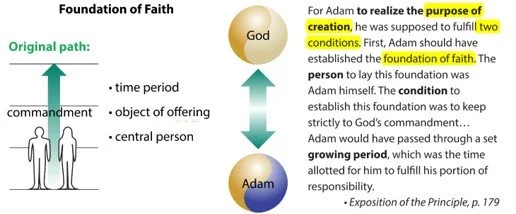
– Exposition of the Divine Principle, p. 179
In other words, as he was growing up in the Garden before the human fall, Adam was to firmly establish his Foundation of Faith, proving his trustworthiness before his Heavenly Parent. He was the central person; he would offer his obedience to the warning to “not eat”; and he would do it consistently and repeatedly throughout his growing period. It was a gradual spiritual path “upward”, that he could ideally complete within the first 21 years of his life.
And based on Abonim’s many words about original life (just one example is here), this applies not only to a single commandment forbidding one evil thing, but to a heartfelt parental desire embracing every good thing Adam did in his youth—most especially those things that Adam was gifted in and that he really enjoyed doing well! He could thus demonstrate—despite his immersion in the powerful excitement of such things—that he had faithfully practiced and finally mastered keeping God with him at all times; it would simply be second nature to him. He could prove not only that he had faith in his Heavenly Parent, but—even more critically—that his Heavenly Parent could have faith in him!
So today, in the Settlement Era, a youth repeatedly practicing that throughout his or her “growth stage” (i.e., ages 7–14), and then continuing with intention throughout his or her “completion stage”, would create an increasingly stronger trust bond between Heavenly Parent and himself or herself. Going back to the opening quotes of this article, it’s what Abonim means when He talks about “manifesting God’s ideal of creation” and restoring this world “in a natural way”.
A great example of this is the old film Chariots of Fire. In case you’ve forgotten, it’s the true story of a missionary son whom God gifted with such extraordinary speed that he earned a place on England’s team for the 1924 Olympics in Paris. He and his sister were planning to return to their mission country when his Olympic opportunity suddenly intervened. His sister was distraught, so he assured her that he believed in God’s missionary purpose for his life. But he added “…God also made me fast! And when I run, I feel His pleasure—to win is to honor Him.” So his sister accepted the temporary detour for competition. The closing scene (use your speakers or earphones) is a precise example of “central figure + offering + time period”. It exemplifies some exhilarating Foundation-building: as Liddle hits his stride, he slips into the Zone, the Flow of the moment, all the while intensely engaged with his beloved Lord.
So now, on to the second condition: The Foundation of Substance. The Principle explains it as the second step that Adam needed “to realize the purpose of creation”. Again returning to the definition of “indemnity”, we see that it’s based on “reversing the course of deviation from the original path”.
As to be expected, the “original path” is explained by the Principle as four behaviors that reverse the four deviant natures. And in many pages and sections afterwards, it connects these four behaviors to our “original nature”:
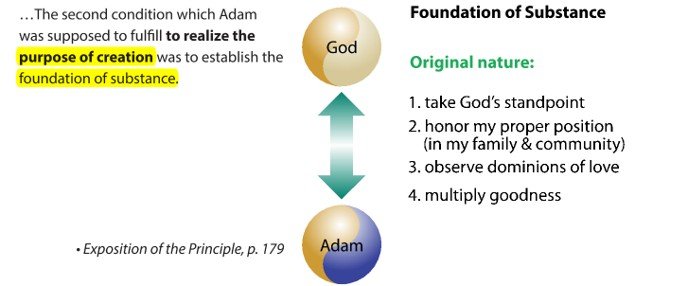
In the Exposition of the Divine Principle, “original nature” is mentioned 40 times[i]. But since the entire Part II of the Principle is devoted to explaining and illustrating “restoration through indemnity”, its emphasis is necessarily on restitution, reversal and removal of fallen nature, so that the Messiah could be well-received and supported substantially in His mission to restore God’s ideal on earth. The simplified list of what would make that possible is on page 193 of Exposition of the Divine Principle. There, it’s stated simply that Cain should have:
1. taken God’s standpoint by loving Abel
2. received God’s love through Abel… respecting him… (and) maintained his proper position
3. obediently submitted to Abel… (and) rectified the order of dominion
4. been receptive… learned… (and) made a foundation to multiply goodness
And that’s largely what we learned and tried to be during our decades in the 40-year Wilderness Era.
But a more complete understanding of humanity’s original nature is what’s needed to actually build the Kingdom of Heaven on Earth in the Settlement Era. It’s worth noting that in the Introduction to the “Exposition” textbook, the second to last paragraph states:
“The words proclaimed on these pages are only a portion of this truth. This volume is merely a compilation of what his disciples have hitherto heard and seen. We believe and hope that when the time is ripe, more profound portions of the truth will be published.”
– Exposition of the Divine Principle, p. 12
To this very end, Cheon Seong Gyeong was published twice in the 2000s and Chapter 4 of Book 4 is one example: Much of its content is from the roughly 30–40 years that followed the publication of the first English version of the Divine Principle. (Abonim also initiated the publication of Unification Thought in the 1960s, wherein 10 of its 11 chapters treated the ideals of the Principle of Creation[ii].
Getting back to where we were, please try to imagine what kind of character a young person would develop if he or she earnestly practiced their original nature intentionally throughout their growth and completion stages[iii]: At the end of the first 21 years of their life, he or she would be a remarkable young adult—and likely a fine matching candidate.
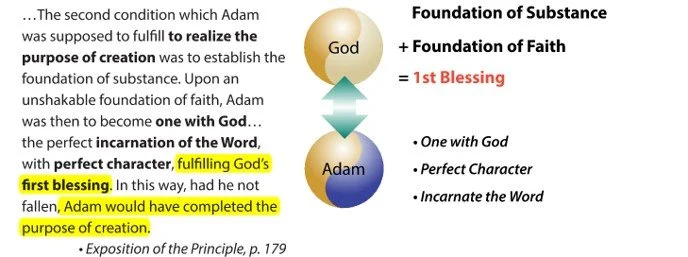
In Principled terms, the young adult would become “one with God”, incarnate “the Word”, have “perfect character” and thereby fulfill “God’s first blessing”. Or, put simply, the young person would fulfill his or her very purpose of existence—he or she would be a joy to Heavenly Parent, a joy to family, friends and community, and experience the joy of his or her own completion!
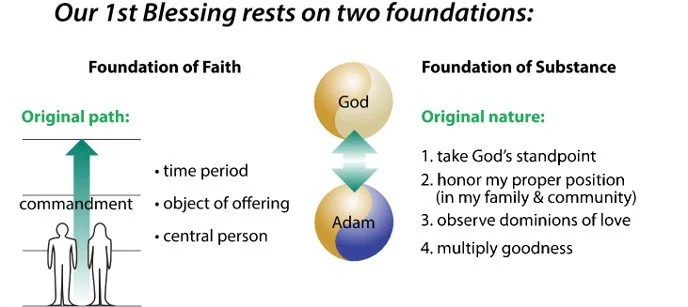
And this would open the door wide for them to accomplish God’s second and third blessings to them—blessed marriage and family and service to others through achieving mastery in their profession.
Conclusion
At this point, it’s hopefully very obvious what these two foundations were originally meant to be: They’re meant not only to restore mistakes we make in life, but more importantly—especially in this post-Foundation Day, CIG Settlement Era—they’re meant to be an integral part of a remarkable, beautiful and even exciting way of living.
Then let’s seriously reconsider the quotes we began this article with—Father Moon’s advice about the best way to approach life in this new era:
“… do not act like wild olive trees. Take the seed of the true olive tree and bear its fruit wherever you take root in the world. … manifesting God’s ideal of creation….” (1990.05.24)
- Cheon Seong Gyeong, Book 12, Chap. 2
“Cheon Il Guk is the original world having nothing to do with the Fall, the world that God envisioned according to His ideal of creation… . The final destination toward which we are advancing… “ (2003.12.10)
- Cheon Seong Gyeong, Book 12, Chap. 2
“… This is the age of the realm of the Fourth Adam. It is … the age of restoration in a natural way.” (1999.10.10)
- Chambumo Gyeong, Book 12, Chap. 3
Going forward, may we as families and as a community live well and enjoy—for the sake of God and others as well as for ourselves!
Endnotes
[1] Adam was the 1st generation; Jesus was the 2nd, True Parents are the 3rd, and the folks they’ve blessed and engrafted are the 4th.
[2] In Exposition of the DP, “original nature” is mentioned on pp. 18-21, 23, 31, 33, 35-36, 41, 68, 73, 75-76, 100, 113, 178, 181, 228, 233, 277, 342, 348-349, 351-354, 356, 371, 376-377. But it’s explained only briefly on page 193.
[3] In the latest edition of Unification Thought, see the chapters on Original Human Nature and the closely related chapters on Axiology and Ethics
[4] If studies about a child’s stages of learning happen to interest you, you might also take a look at the landmark works of Vygotsky, Piaget and Erikson.