
Idealism and I
Over the decades since I began teaching back in the late 70s, I’ve sometimes noticed young people being pulled into activism because of their idealism and their anger with persistent injustice in society. And now, five decades later, many of those young people are adult spouses and parents, and thankfully, much of that idealism remains intact. Nevertheless, when the matter of activism comes up, I often feel disquieted. I wear my idealism on my sleeve, yet I can’t conceal my reservations about the intensity of their fervor to combat injustice.
That’s because I’m tempered by the memory of my own experience back in the 60s and 70s, when I was a teen in high school and a 20-something in college. The Vietnam war was full on. I knew a friend’s brother and a next-door neighbor who’d fought there and come back very disillusioned, their innocence and conviction gone.
When the protest movement against the war and everything else happened, I eventually joined it and had my first run-in with police. When told to disperse, I objected reasonably that I wasn’t doing anything wrong. In my inexperience, I expected a correspondingly civil reply. Instead, the officer shouted commands at me with clear intention to intimidate; I tried again to communicate and was again bellowed at.Ⅺ That incident completely altered my understanding of police; it seemed to confirm all the “us against them” bad-mouthing that was prevalent.
Years of college had already turned me agnostic and now I leaned toward the widespread distrust of authority—not only in religion, but in government and education, as well. I’d fallen into cynicism and even some of the arrogance that can attend that dark mindset.

Years of college had already turned me agnostic and now I leaned toward the widespread distrust of authority—not only in religion, but in government and education, as well. I’d fallen into cynicism and even some of the arrogance that can attend that dark mindset.
At the height of the weeks of mounting protest, students at liberal arts schools across the nation were involved in massive demonstrations, forcing school closures and police confrontations. The momentum was so strong that even my own less-political engineering and design school was engulfed and I participated in its takeover and closing. When we occupied some of the office buildings, I personally took over one professor’s office for days and nights. We waited as student leaders forced the administration to meet them and accept our demands.
The main leader was a charismatic macho guy who proudly styled himself after the revolutionary hero Che Guevara. He sported that man’s hair, beret, tactical jacket, and he had a similarly dressed young woman as his sidekick. They seemed to bask in their roles as the high-profile commanders of the school’s protesting student body.
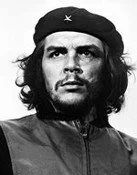
The main leader was a charismatic macho guy who proudly styled himself after the revolutionary hero Che Guevara. He sported that man’s hair, beret, tactical jacket, and he had a similarly dressed young woman as his sidekick. They seemed to bask in their roles as the high-profile commanders of the school’s protesting student body.
But as the school’s stalemate dragged on, I sensed that we weren’t being told all the facts that we’d been assured were forthcoming. I began suspecting a concealed agenda and that just causes were being used as a subterfuge to achieve them. We were of course aware that our campus activism was one part of a larger movement to tear down “The Establishment”. It was so widespread that there was even a soundtrack provided by the rock bands of the time and played by the new, alternative radio stations. Ⅻ I was surrounded by these things, but not entirely convinced by them. I observed, with reservations, that there was too much emotionalism and too little restraint. There was a bravado to the talk, an aggression to the behavior and an abandon to the music that belied trust. Still, it was pretty heady for a while, as the counterculture seemed to gain momentum. We started believing that a massive social change might truly be imminent.
But that hope evaporated when the confrontation with police and other enforcement agencies escalated into violence. And when protesting students at Kent State University were shot and killed, that marked the beginning of the end of the revolution, for many. We’d gone up against “The Man” and learned that violently confronting armed authorities wasn’t actually viable strategy.
Realizing that change wasn’t going to come via these means, I withdrew and resumed looking for other answers. The “revolution” passed, I graduated with honors, but I didn’t look for work as college grads normally did. I instead hoped that, if God existed, I’d be guided. And before summer’s end, I met the movement. That first year in was the hardest of my life: I’d sought a path to enlightenment, release and inner peace but instead found that humanity exists in a state of war between Heaven and hell, in which neutrality isn’t really possible.
Back then, we studied just three things: the Principle (with remarkable insights into the Bible and world history), Communism: Critique and Counterproposal (a dissection of its diabolical aims and means), and Unification Thought (a horizon-expanding insight into original life). And these were intense, in-depth sessions of seven, 21, 40 and 120 days, repeatedly. And then, 10 years later in 1985, I was in the Philippines to establish CARP and Wonhwa Dō (martial arts).
Some big, hard realities there were a history of colonization, foreign exportation of natural resources, and widespread poverty due to an enormous imbalance in the distribution of wealth. These were realities that directly impacted everyone’s’ life, including the lives of my brave students and my own blood kin. And they were a perfect storm of troubles that could ignite adults fighting to support their families and idealistic youth longing for justice. Two of my first cousins were activists—one was a student leader who was arrested, broken and died young; another was a lawyer who did pro-bono work for activist poor and was embittered.
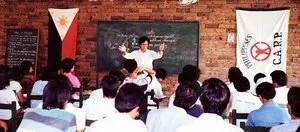
So, while I was teaching Unificationism on campus, trying to usher in a new age of God-centered global family and presiding over the nation’s CARP and Wonhwa Dō chapters,
the radical left was recruiting support for violent revolution and creating communist “cells” of students on those very same campuses. The military wing of communism in the Philippines—both then and now—is the NPA (New Peoples’ Army). One of my CARP leaders told of an instance in his province where the NPA held a public execution of a townsman who encouraged resistance to them. And on campus, CARP became the clear enemy of communism when we started adding CAUSA Worldview lectures to our regional seminars for CARP leaders and students. The CAUSA organization was hosting powerful seminars throughout Latin America and then in other nations, including the Philippines, to warn against the dangers of communism.
My education climaxed when the People Power Revolution against the government of Ferdinand Marcos rose up and took to the streets. Just outside of our office on the main thoroughfare between Manila and Quezon City, over a short period of days, barricades of burning tires, cars, gutted buses and other vehicles were set up to oppose the army and impede its vehicles. Sporadic shooting broke out and this chaos was what the radical Left was counting on. It provided the expected opportunity to step up, take control of the popular revolt, push out the old government and install themselves into power, just as they’d done in other developing nations around the world. The revolt would succeed, the people would feel they’d been victorious and many of the radical left’s spokespersons would appear as heroes and would naturally assume leadership in the new government that was supposed to be provisional. But as they implemented their plans and cemented their control, it would become apparent to the people that they’d been duped and that their new masters were more brutal than the old ones. That was the playbook that CAUSA had identified in Asia and that it was intensely educating Latin America against, soon followed by work in other developing nations like the Philippines.
Fortunately for the Philippines, its People Power Revolution wasn’t hijacked by the left because there wasn’t a power vacuum after the revolution: there already was a president-in-waiting who was supported by the Army, and they were fully aware of the threat of communism. This person was the widely-respected and widely-supported widow of the opposition leader who’d been assassinated some years earlier. She was sincerely committed to democracy, as was the army general who’d defected in order to support her. And so that opportunity for the communists to insert themselves into power and turn the Philippines into the next Asian communist nation was thwarted.
In 1992, I went to St. Petersburg, Russia to visit college students and to staff a martial arts seminar. The flight provided a psychological experience that was and remains a unique experience in my life. I’d only heard about East Germany and the Berlin Wall, read about Lenin and Stalin, and though I lived my childhood during the Cold War, I’d never actually experienced life under a totalitarian regime. But on that trip to St. Petersburg—formerly Leningrad—we stopped in Finland to transfer flights from a normal airline to one that flew the last leg into Russia. My traveling companion to the martial arts seminar was a professional security guard. But when the passengers were queued up to transfer planes, the unusual tension in the atmosphere was palpable: everyone was totally quiet, there was no conversation, and no one made eye-contact with anyone else. My companion was spooked and asked me to carry his passport for him. I think he feared that his American-ness could single him out to be pulled aside for questioning or a search. Fortunately, that didn’t happen, but the next hours on this last leg of the trip into Russia happened in absolute quietness. It appeared habitual for people to carefully avoid calling attention to themselves by speaking with anyone else. It wasn’t a relaxing flight at all—the general sense of paranoia was pervasive and dense. My companion and I had never experienced anything like it in our lives.
In the mid-90s, I took five trips to China to staff a study-exchange program. Each two-week trip took us to two conferences in a region. We went to colleges and universities outside of the capital city and were able to get a sense of normal peoples’ lives, far away from the big, urban political center of the country. But on every trip, we were always and unfailingly accompanied by a party representative from Beijing. Their clear purpose was to surveil us and make sure that we didn’t get too close to any of the professors or students and share anything that might be ideologically conflicting, or learn anything about their actual lives that would be damaging to the approved, orthodox image of life that they wanted to project to our party. I managed to hear an unforgettable life-experience anyway.
For me, having lived through all these events firsthand, a lasting lesson was learned. The events absolutely confirmed experiences I’d already had as a CARP foot-soldier in the USA:
When we’d have speaking events on campus, we had heated stand-offs with students who opposed CARP. I believe that many were simply conscientious and were possibly unaware that their core student leaders were radically Left.
I was befriended by a young Vietnamese refugee who’d been imprisoned and tortured by the Viet Cong in his country for fighting against them. Despite his age, he had a worn intensity in his manner and a smoldering lethality in his martial arts that I’d never seen.
And while fundraising, I’d stumbled into low-income housing for entire communities of displaced Cambodian families who had to flee here because of the takeover of their country by the Khmer Rouge. They lived in poverty, depression and grief. They’d lost not only loved ones and their ancestral homes, but their entire homeland. They could only find refuge in this completely foreign land, with a language and culture that they couldn’t understand. Seeing them huddled in their quarters, I sensed their gnawing uncertainty about the reliability of America’s largesse.
There is another more recent experience that further solidified my already cautious view of the world. On Sept. 11, 2001, I was working in a tall office building eight blocks north of the World Trade Center. I was on the north side of my building when a loud furor broke out on the south side, so I ran with others to see what was causing the ruckus. We found everyone staring in shock and disbelief at a huge blackened burning hole in one of the World Trade Center towers, smoke pouring out of it. Someone said it had been hit by a plane, so I thought it must have been some poor fool who’d accidentally flown into the building. But as we watched, another plane approached and it wasn’t a small private plane but a large commercial airliner. And it went right into the second of the Twin Towers, exploding and creating another huge blackened hole. At that point—and with the memory of the recent bombing of another business building in the same area—I ran to my desk, grabbed my things and rushed many long flights down the nearest packed stairwell. When I exited the building at ground level, the street outside was littered with debris, and haze and smoke were billowing into the area from the direction of the impacts we’d witnessed. So I ran to the subway and caught the last northbound train to the George Washington Bridge, because that was the farthest point north, away from the tip of Manhattan, that the train would reach. When I got to the streets, they were packed and I found a vantage point overlooking the Hudson River where crowds were gathered, staring south in disbelief at the burning Twin Towers. And then they slowly collapsed in clouds of smoke. I rushed to hitch a ride in a pickup truck that was going to the bridge, hoping that it would make it across before it was closed, because it surely would be—either by police or by worse. I sat in the back of that truck in shock, as others piled in. I don’t recall anyone speaking, just hoping that we’d not be turned back before we could make it across. When it did reach the NJ side, we stumbled out, I thanked the driver and then slowly walked the crowded distance home in silence, through the width of two towns, until I reached home.
This isn’t a memory I can forget. But it’s also something I don’t talk about. Because it’s not likely—excluding a first responder or a war veteran—that a normal person could grasp an event that sudden, massive, violent and extreme. I remember how Aleksandr Solzhenitsyn’s book The Gulag Archipelago was considered required reading for early members of the movement, when it was still heavily committed to the VOC mission. I knew about it, but avoided reading it, because I didn’t want to bear the depressing burden of such knowledge. I rationalized that I’d seen enough in my life, heard from missionaries to occupied nations and friends who’d been in Berlin before the wall came down, and felt enough from my Dad who’d fought in WWII. That was enough to for me to take part in the battle Abonim was leading.
And so, decades later as I began noticing that young people in America are being drawn into activism because of their belief in the ideals of social justice, the memory of what I’d experienced in my own youth comes back to me. It’s alarmingly similar to the stratagems that the radical Left had employed to prey on the sincere idealism of my generation’s youth—in America, in the Philippines, and in other troubled nations in Latin America, Africa, Asia and elsewhere.
So, I feel it’s crucial to look carefully before leaping into something, despite peer pressure or appeals to the conscience. Just as in our not-so-distant past, missteps today can increase division and enmity, lead to violence and culminate in tragedy. And individually, they can lead to a path away from the Three Blessings—a path away from God and faith, away from true love, and away from one’s original creative potential. I remember that I’d observed, studied and even prayed for other options when I arrived at that crucial crossroads in my youth. And by sheer grace, after losing my idealism, I could find it again; and it’s sustained me all my life.
2024.11.09; amended in 2026
Related:
· Idealism isn’t merely cerebral, it’s pragmatic. See The Practical Value of Vision .
· The Principle crucially reminds us of the possibility that the conscience can be misled: “…As the , the standard of our …” (Exposition of the DP, p. 50) See Thoughts on “Conscience” .
Endnotes below ⇊
ⅪⅪ Much later, I learned that shouting is the first action that an officer is trained to do to assert control in tense situations.
ⅫⅫ Music impacted many young boomers, so I include these three links (in case music trivia means something to you):
Though the raw soundtrack of 70s revolution rock (Ohio, For What It’s Worth, Volunteers of America) sometimes grated on my ears, it clearly reflected widespread emotions that I hear echoes of today. But there’s one song that, to me, reflects post-revolution disillusionment: Won’t Get Fooled Again