
And the Lord Turned
by Robert Beebe
All photos submitted by R. Beebe
The clear starry night gleamed down from above. The night was colder than usual for that time of the year—the time of Passover when all of Israel remembered that fateful night thousands of years earlier. Then, the hand of God had protected the households of the Israelites in Egypt while the wind of death struck the firstborn of the Egyptians, including the son of the Pharoah himself. This night would be another fateful night in the annals of history, but of a different sort. A chill wind blew up from the Kidron Valley and over the body of one whom people called ‘rabbi’ lying prostrate on the ground.
Beads of sweat the color of blood formed on Jesus’ forehead as he rose from an hour-long prayer for the third time. He turned and looked behind him to see his three most trusted disciples sleeping under an olive tree. With sorrowful eyes and a heavy heart, Jesus approached them slowly. He came to a stop several paces from them and stood watching them slumped over one another, deep in sleep. Several minutes passed. Rustling noises and men’s voices could be heard approaching from the path leading to Jerusalem.
“Are you still sleeping and taking your rest?” Jesus said suddenly, shaking Peter, James and John by the shoulders. “Behold, the hour is at hand, and the Son of man is betrayed into the hands of sinners. Rise, let us be going; see, my betrayer is at hand.”
While he was still speaking, Judas came, one of the 12, and with him, a great crowd with swords and clubs, from the chief priests and the elders of the people. Peter and the others rose groggily. Even before they all could get on their feet, the temple officers in the crowd seized Jesus roughly, binding his hands behind his back.
“Have you come out as against a robber, with swords and clubs?” asked Jesus, staring down the chief priests and elders who had come out against him. “When I was with you day after day in the temple, you did not lay hands on me. But this is your hour, and the power of darkness.”
By now the rest of Jesus’ disciples had awoken and were drawing near the crowd gingerly. They stopped several yards away and began to look at one another, trying to decide what to do. Despite hints that Jesus had made about facing some imminent danger, the suddenness of Jesus’ arrest had caught them completely by surprise. Several of them shot furtive glances at Peter. Not two hours earlier, Peter had told Jesus he was ready to go to prison and even death with him. Now he stood transfixed, as if his feet were bolted to the earth.
Seeing the disciples present, one of the chief priests made threatening gestures towards them. In panic, they all turned away and fled into the dark night.
Peter, too, ran and ran. Stumbling over the gnarled roots of the olive trees, he knew not where he was going. His legs had taken on a life of their own, carrying his confused mind. After several minutes, he stopped. Silence. No one was following him.
Peter turned and retraced his steps back to the grove where Jesus was arrested. He could hear only muffled voices in the direction of the walled city. Cautiously, he began to follow the crowd, which was bringing Jesus to the house of Caiaphas, the high priest. He arrived at the courtyard just as they were bringing Jesus into the house. Peter could see just the back of his head as he disappeared through the doorway.
It was after midnight. The night air was becoming colder by the minute. Caiaphas’ guards kindled a charcoal fire in the center of the courtyard. A dozen men and women sat around it, warming themselves. Trying to stay as inconspicuous as possible, drawing his hood over his head, Peter joined them. His mind raced through a thousand thoughts—and remained paralyzed at the same time. A smoldering fear had taken possession of him, consuming his soul. He paid ho attention to the conversation around him.
“This man also was with him.”
Peter suddenly became conscious of a sea of faces staring at him. Standing up and taking a step backwards, he said to the woman who had made the statement, “I don’t know what you are talking about.” He hurried out onto the porch that looked out over the Hinnon Valley to the south of Jerusalem. While standing at the railing, looking into the distance, Peter heard footsteps approaching from behind.
“Surely, you were with Jesus of Nazareth,” said another woman’s voice.
Peter whirled around to face the woman—a maid. He heard words blurting out of his mouth as if spoken by someone else. “I do not know him.” Peter scurried down the steps leading into the valley.
“What’s wrong with me?” Peter thought. “Why am I so afraid?” He held out his hands. They were shaking. He slumped down on the steps, his mind a jumble of self-accusation and fear. Now loud shouts emanated from inside the house above him. Accusing voices. A smack upon a face. Tears began to roll down Peter’s cheeks. Was this how it was going to end? They were going to kill his beloved master. He would never see him again. It was happening all too quickly.
Peter sat on the steps for a long time, trying to summon up the courage to go back to the courtyard—and do what? Weren’t the circumstances beyond his control? Yet, still, wasn’t there something he could do to help his master? Without any clear plan, he stood up and slowly began walking up the steps. As he approached the courtyard, there appeared to be a lot of movement inside the house. Peter could see people exiting through a side door. He moved closer to get a good look. He asked one of the bystanders what was happening.
“They’re taking him to the praetorium to see the governor.” The speaker, a balding old man, peered at Peter curiously. “Say, certainly you also were with him, for your accent betrays you.”
Peter looked down at the old man. Once again, that voice was speaking through his mouth. With great force he said, “I swear upon my soul, I do not know that man.”
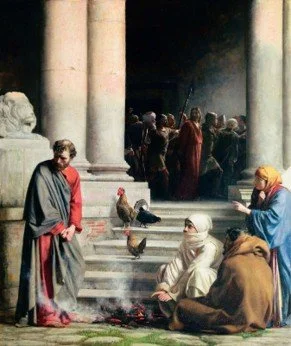
As the words were passing through his lips, Jesus appeared in the doorway; his hands bound behind his back; his face swollen and bloodied with wads of spit slowly creeping down his cheeks into his beard. As if looking for him, Jesus turned his head towards Peter. As their eyes met, a cock crowed in the distance, and Peter remembered how Jesus had said to him, “Before the cock crows today, you will deny me three times.”
Peter felt as if he had been stabbed with a knife. He suddenly had trouble breathing. His mind was swimming. What had he done? A rush of memories of his time with Jesus flooded into his mind. He remembered the day he had first met Jesus at the Sea of Galilee; how his words had stirred his heart; and then sitting at his master’s feet day after day, basking in his love, and loving him in return. Now he felt so distant. The rowdy crowd was mocking and accusing this innocent Jesus—and he had done nothing to help him.
But as Peter held Jesus’ gaze, he began to feel a strange sensation. Although their eyes met for but a second, it seemed to last for an eternity. Peter felt that Jesus was looking not only at him, but at all humankind. In those eyes he detected not a hint of condemnation, accusation or resentment. Instead, he saw compassion and forgiveness.
Jesus’ passing glance elicited within Peter’s mind and heart a mix of powerful emotions. He immediately realized the great chasm that existed between himself and Jesus. He contrasted Jesus’ absolute devotion to God with his own feeble devotion to Jesus. He suddenly understood that his three years of discipleship was more centered on himself than it was on Jesus. For that reason, he could not find the courage to come to his aid in his master’s moment of need. A feeling of shame overwhelmed him.
At the same time Peter could comprehend more than before the depth of Jesus’ love. Even now, as he was walking the path of death, Jesus thought not of himself but of Peter and about his situation and his future. Comparing his self-centered mind to the self-sacrificing example of Jesus, Peter felt ever so poignantly his own shortcomings. After watching Jesus being led away, he went out from the courtyard and wept bitterly.
Down in the valley, weeping, Peter felt a deep divide within himself. Each side sought to gain control over his mind. He strongly felt Satan’s accusation against him that he had betrayed his Lord. Yet, as he recalled Jesus’ gaze, he knew this was not how God felt. Slowly, Peter felt a transformative explosion taking place in his mind. The remembrance of Jesus’ loving and compassionate gaze dragged Peter from the depths of despair to where he felt a stirring desire in his heart to live for his Lord. A new Peter was being born, the one he was meant to be—the Rock upon which the resurrected Jesus would build his church.